Thera4Age News & Events
All Upcoming Thera4Age Seminars:
- 21.04.2026 – Prof. Dr. Tilman Grune
Deutsches Institut für Ernährungsforschung Nutrition Potsdam-Rehbrücke - 05.05.2026 – Prof. Dr. Maria Cristina Polidori
CECAD - Cologne
- 19.05.2026 – Prof. Dr. Andrea Heinz
Department of Pharmacy, University of Copenhagen
09.12.2025 Thera4Age Seminar with Guest Speaker Dr. Niki Chondrogianni (16:00, Großer Hörsaal at the Biochemistry Building)
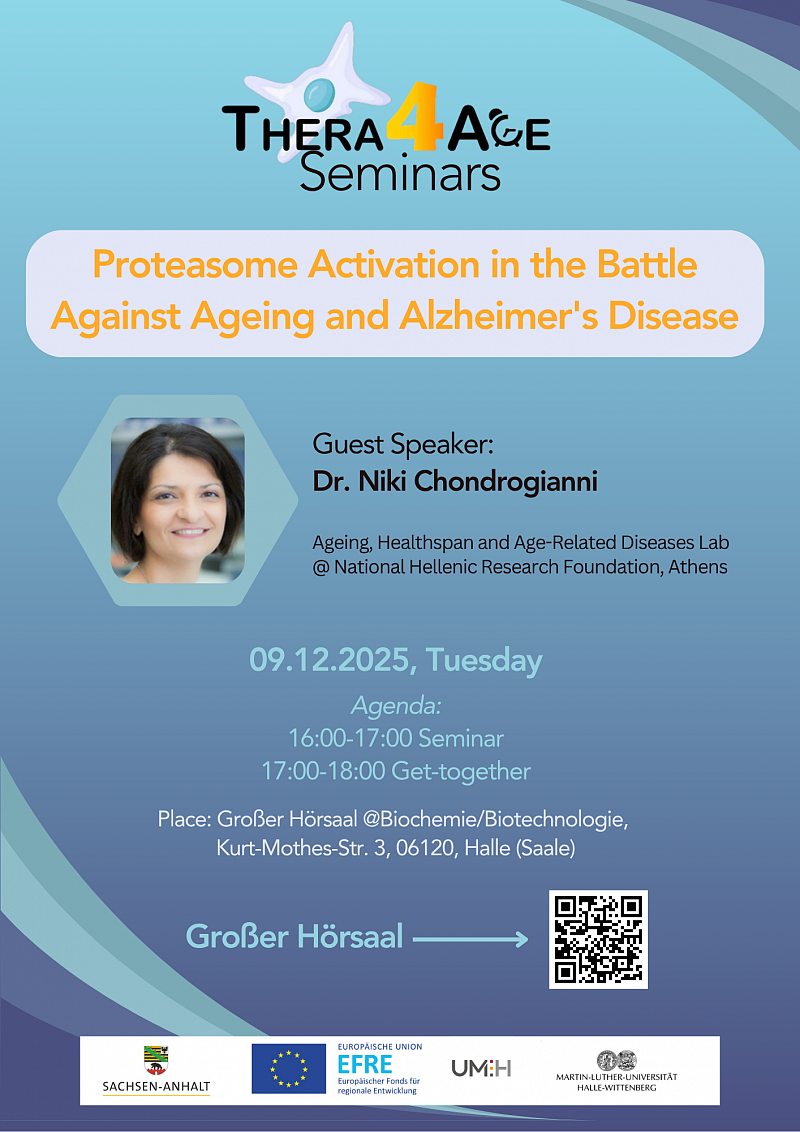
We are pleased to announce that our next Thera4Age seminar will take place on Tuesday, December 9, 2025, at 16:00 in Großer Hörsaal at the Biochemistry Building, Kurt-Mothes-Str. 3, 06120, Halle (Saale). We are delighted to welcome Dr. Niki Chondrogianni from the Institute of Chemical Biology at the National Hellenic Research Foundation in Athens as our Guest Speaker.
Title of Presentation: Proteasome activation in the battle against ageing and Alzheimer’s disease
Abstract: „My group focuses on unveiling the mechanisms that affect human ageing, longevity and Alzheimer’s disease, with the proteasome being our main target. We are interested in revealing the regulation of the proteasome and its function along with its cross-talk with other mechanisms of proteostasis. Moreover, we seek to identify natural or synthetic compounds with anti-ageing and/or anti-aggregation properties and to investigate the involved mechanisms. We mainly use the nematode C. elegans, the replicative senescence model (human primary fibroblasts that senesce in vitro) and human cells of neuronal origin. Our ultimate goal is the identification of pathways and compounds with direct application in the field of anti-ageing (nutrition, cosmetics, drugs) and anti-aggregation of proteins that characterize several proteinopathies. Finally, we take advantage of the nematode C. elegans to provide a fast toxicity testing of drugs or novel bioactive compounds in the level of a multicellular organism while respecting at the same time the 3Rs (Reduction, Replacement, Refinement). The most recent results on the effects of proteasome activation in the deceleration of Alzheimer’s disease phenotype progression will be presented1-4. Furthermore, unpublished results on the mechanisms involved in the proteasome activation-mediated lifespan extension will be discussed.“
- Gioran A., Paikopoulos Y., Panagiotidou E., Rizou A.E.I., Nasi G.I., Dimaki V.D., Vraila K.D., Bezantakou D.S., Spatharas P.M., Papandreou N.C., Magafa V., Lamari F.M., Iconomidou V.A., Chondrogianni N. Beneficial Effects of Sideritis clandestina Extracts and Sideridiol against Amyloid β Toxicity. Antioxidants (Basel). 2024, 21;13(3):261. doi: 10.3390/antiox13030261.
- Panagiotidou E., Gioran A., Bano D. and Chondrogianni N. Neuron-specific proteasome activation exerts cell non-autonomous protection against amyloid-beta (Aβ) proteotoxicity in Caenorhabditis elegans. Redox Biol. 2023, 65:102817. doi: 10.1016/j.redox.2023.102817.
- Vasilopoulou M.A., Gioran A., Theodoropoulou M., Koutsaviti A., Roussis V., Ioannou E., Chondrogianni N. Healthspan improvement and anti-aggregation effects induced by a marine-derived structural proteasome activator. Redox Biol. 2022, 56:102462. doi: 10.1016/j.redox.2022.102462.
- Chondrogianni N., Georgila K., Kourtis N., Tavernarakis N., Gonos E.S. 20S proteasome activation promotes life span extension and resistance to proteotoxicity in Caenorhabditis elegans. FASEB J. 2015, 29(2):611-22. doi: 10.1096/fj.14-252189.
18.11.2025 Thera4Age Seminar with Guest Speaker Prof. Dr. Werner Weitschies (16:00, Großer Hörsaal at the Biochemistry Building)

We are pleased to announce that our next Thera4Age seminar will take place on Tuesday, November 18, 2025, at 16:00 in Großer Hörsaal at the Biochemistry Building, Kurt-Mothes-Str. 3, 06120, Halle (Saale). We are delighted to welcome Prof. Dr. Werner Weitschies, Biopharmaceutics and Pharmaceutical Technology, University of Greifswald, as our Guest Speaker.
Title of Presentation: Oral Drug Delivery: Insights From Magnetic Resonance Imaging
Abstract: „The behavior of oral dosage forms in the gastrointestinal tract and thus also the kinetics and possibly the extent of drug absorption is the result of a complex interplay of formulation parameters, drug properties and gastrointestinal physiology. Understanding the interplay between gastrointestinal physiology and oral drug delivery systems is therefore key to the successful development of formulations for poorly absorbable drugs. Imaging can make an important contribution to this understanding. Despite the highly dynamic nature of gastrointestinal motility, advances in MRI technology now enable real-time measurements that provide new insights into gastrointestinal transport processes, particularly fluid transport. This presentation will provide an overview of the current state of knowledge on human gastrointestinal motility, discuss pitfalls in the use of animal models in formulation development, highlight new insights into the mechanisms of rapid fluid transport in the postprandial stomach (gastric pathway) and intestine (intestinal pathway) and discuss the implications for drug absorption.“
07.10.2025 Thera4Age Seminar with Guest Speaker Prof. Dr. Stephan Schilling (16:00, Großer Hörsaal at the Biochemistry Building)

We are pleased to announce that our next Thera4Age seminar will take place on Tuesday, October 7, 2025, at 16:00 in Großer Hörsaal at the Biochemistry Building, Kurt-Mothes-Str. 3, 06120, Halle (Saale). We are delighted to welcome Prof. Dr. Stephan Schilling, Drug Design and Target Validation, Fraunhofer IZI, Halle, as our Guest Speaker.
Title of Presentation: Posttranslational Modifications (PTMs) as Target Structures for Immunotherapy of Amyloidosis
Abstract: „Compelling evidence suggests that PTMs contribute to development and progression of protein misfolding disorders, which are characterized by aggregation and deposition of proteins, typically in large fibrillary protein aggregates. Motivated by these results, we aim at deciphering the role of certain PTMs in protein misfolding disorders, with emphasis on neurodegeneration and selected systemic amyloidosis such as Alzheimer’s and Parkinson’s disease and Transthyretin (TTR) amyloidosis (ATTR). Our research is focused on generation of monoclonal antibodies directed against these modifications and their potential value as future therapeutics [1-3]. In the talk, current clinical advances (such as the approval of the antibody Donanemab [4]) will be discussed, and future perspectives with regard to target other modifications will be addressed [5].“
[1] Schilling et al., Molecules. 2018; 23: 1068. https://doi.org/10.3390/molecules23051068 .
[2] Gnoth et al., Alzheimers Res Ther. 2020; 12: 149. https://doi.org/10.1186/s13195-020-00719-x .
[3] Schrempel et al., Acta Neuropathol. 2024; 148: 78. https://doi.org/10.1007/s00401-024-02824-9 .
[4] Sims et al., JAMA. 2023; 330: 512–527. https://doi.org/10.1001/jama.2023.13239 .
[5] Köppen et al., Amyloid. 2024; 31: 184–194. https://doi.org/10.1080/13506129.2024.2358121 .
Thera4Age Project Meeting 2025 (T4A Klausurtagung 2025)
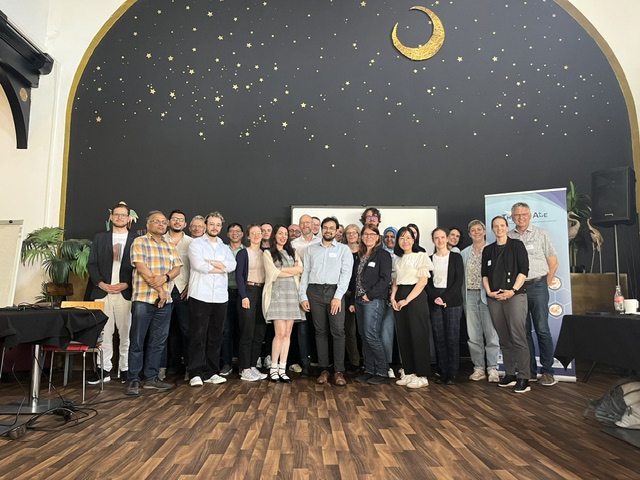
On June 11, 2025, Thera4Age consortium gathered at the Kolonnaden-Saal (Bergzoo Halle) for a productive and inspiring project meeting. The day brought together project partners for an intensive exchange of ideas, progress updates, and future planning.
The event opened with a warm welcome by Prof. Christian Wischke and a brief overview of the meeting’s objectives, followed by an engaging keynote lecture from Prof. Anne Seidlitz (Freie Universität Berlin) as the advisory board member of Thera4Age. In her talk, Prof. Seidlitz presented their research on individualized dosage forms tailored to vulnerable populations such as the ageing society.
The meeting featured comprehensive updates from all five subprojects. Presentations covered a wide range of topics: Dr. Franziska Seifert and Nico Kibria summarized their work on the management of chronic wounds such as decubitus ulcer with elastin-based approaches. Dr. Nikolaos Giannareas and Phuong Vo discussed their research on the modulation of hepatosenescence by dietary components. Dr. Shifa Kajeh Saleem and Dr. Seyhmus Bayar highlighted efforts on enhanced immune responses with particulate vaccine carriers. Prof. Karsten Mäder, Dr. Ahmad Hivechi and Dr. Padmanabhan Vakeel reported on the delivery of senolytics for regulation of senescent cells. Dr. Clément Linger and Dr. Markus Petermann shared progress on photoacoustic imaging as a diagnostic tool and on novel pharmacotherapies for colorectal carcinoma. Each session sparked lively discussions and valuable feedback among participants.
Last session of the day was moderated by Prof. Wischke and Dr. Enise Ece Gurdal, where all participants contributed to a collaborative mind map, exploring ideas for the future development of the consortium. This interactive session fostered new perspectives on strengthening interdisciplinary collaborations, as well as on advancing long-term research and coordination efforts.
The day concluded with a relaxed joint dinner at Restaurant Ruine, where informal discussions continued in a warm and collegial atmosphere.
We thank all presenters and participants for their valuable contributions, and extend our special thanks to all T4A PIs (Prof. Sonja Keßler, Prof. Johannes Wohlrab, Prof. Karsten Mäder, Prof. Markus Pietzsch, Prof. Christine Dierks, Dr. Markus Petermann, Prof. Jan Laufer, Prof. Gabriele Stangl) and speakers (Prof. Christian Wischke, Prof. Andreas Simm) for their great support and insights. We look forward to moving ahead together with Thera4Age!