




Microparticulate Carrier
Sustainable microparticulate drug delivery systems and particle modification
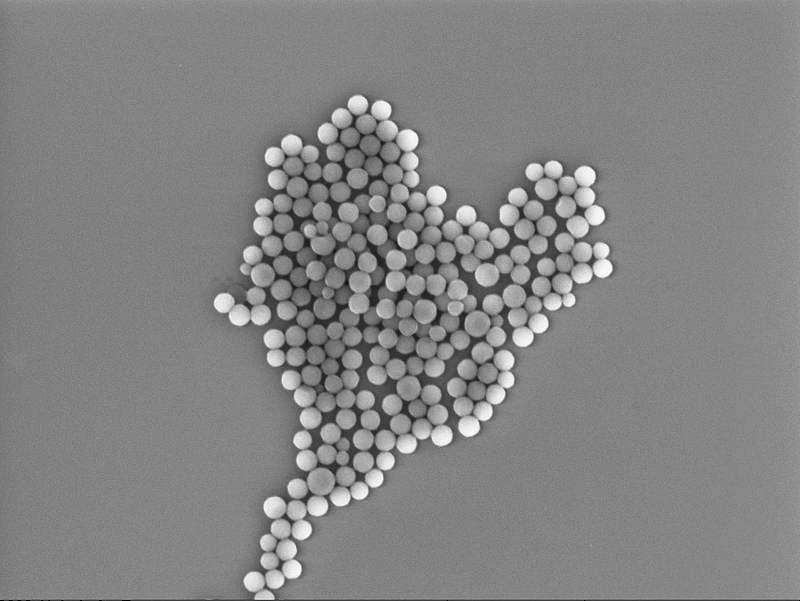
Polymeric microparticles are injectable carrier systems that enable localized drug administration directly into tissue, allowing a drug payload to be slowly released to mediate either local or systemic biological effects. The preparation of such particles can be performed by traditional batch emulsification or more advanced techniques, including droplet-based microfluidics. We apply our expertise in designing and constructing microfluidic setups using glass capillaries as well as through soft lithography. Soft lithography, due to its unique features, also allows for precise modulation of particle composition, either during or after production.
In a similar manner, we are investigating the surface and internal structures of the produced particles, aiming to control and tailor these properties at both molecular and morphological levels. In several projects, we are also addressing sustainability by expanding the use of bio-sourced materials for particulate carriers and by modifying the characteristics of stock particles to accommodate different types of payloads. The intended outcomes of such modifications include improved stability, customized drug release profiles, and controlled biorecognition and degradation.
Exemplary own publications in this field include:
F. Störmann, T. Roch, A. Lendlein, C. Wischke. Microfluidic Templating and Initiator-Free Photocrosslinking of Protein-Loaded PCL Microcapsules, particle and particle systems characterization 2024, 2300099; http://doi.org/10.1002/ppsc.202300099
F. Friess, A. Lendlein, C. Wischke, Size control of shape-switchable micronetworks by fast two-step microfluidic templating. J Mater Res 36 3248-3257 2021. DOI:10.1557/s43578-021-00295-2
C. Wischke. Concepts for efficient preparation of particulate polymer carrier systems by droplet-based microfluidics. Int J Pharm 584 119401 2020. https://dx.doi.org/10.1016/j.ijpharm.2020.119401
N. Brunacci, C. Wischke, T. Naolou, A. Patzelt, J. Lademann, A.T. Neffe, A. Lendlein, Formulation of drug-loaded oligodepsipeptide particles with submicron size. Clin Hemorheol Microcirc 77 201-219 2021. https://dx.doi.org/10.3233/CH-200977
C. Wischke. Concepts for efficient preparation of particulate polymer carrier systems by droplet-based microfluidics. Int J Pharm 584 119401 2020. https://dx.doi.org/10.1016/j.ijpharm.2020.119401
C. Wischke, M. Kersting, A. Welle, L. Lysyakova, S. Braune, K. Kratz, F. Jung, M. Franzreb, A. Lendlein. Thin hydrogel coatings formation catalysed by immobilized enzyme horseradish peroxidase. MRS Advances 5 773-783 2020. https://dx.doi.org/10.1557/adv.2020.218
C. Wischke, E. Baehr, M. Racheva, M. Heuchel, T. Weigel, A. Lendlein. Surface immobilization strategies for tyrosinase as biocatalyst applicable to polymer network synthesis. MRS Advances, 3 (2018) 3875-3881. https://doi.org/10.1557/adv.2018.630
N. Brunacci, C. Wischke, T. Naolou, A.T. Neffe, A. Lendlein. Influence of surfactants on depsipeptide submicron particle formation. Eur J Pharm Biopharm, 116 (2017), 61-65. http://dx.doi.org/10.1016/j.ejpb.2016.11.011
A. Dal Bianco, C. Wischke, S. Zhou, A. Lendlein. Controlling surface properties and permeability of polyglycerol network films. Polym Adv Technol, 28 (2017), 1263-1268. http://dx.doi.org/10.1002/pat.3917
S. Mathew, S. Baudis, A.T. Neffe, M. Behl, C. Wischke, A. Lendlein, Effect of diisocyanate linkers on the degradation characteristics of copolyester urethane drug carrier matrices. Eur J Pharm Biopharm, 95 (2015), 18-26. https://doi.org/10.1016/j.ejpb.2015.03.025
S. Mathew, A. Lendlein, C. Wischke*, Degradation Behavior of Porous Copolyester Microparticles in the Light of Dynamic Changes in Their Morphology, Macromol Symp, 309-310 (2011) 123-133. http://dx.doi.org/%2010.1002/masy.201100059